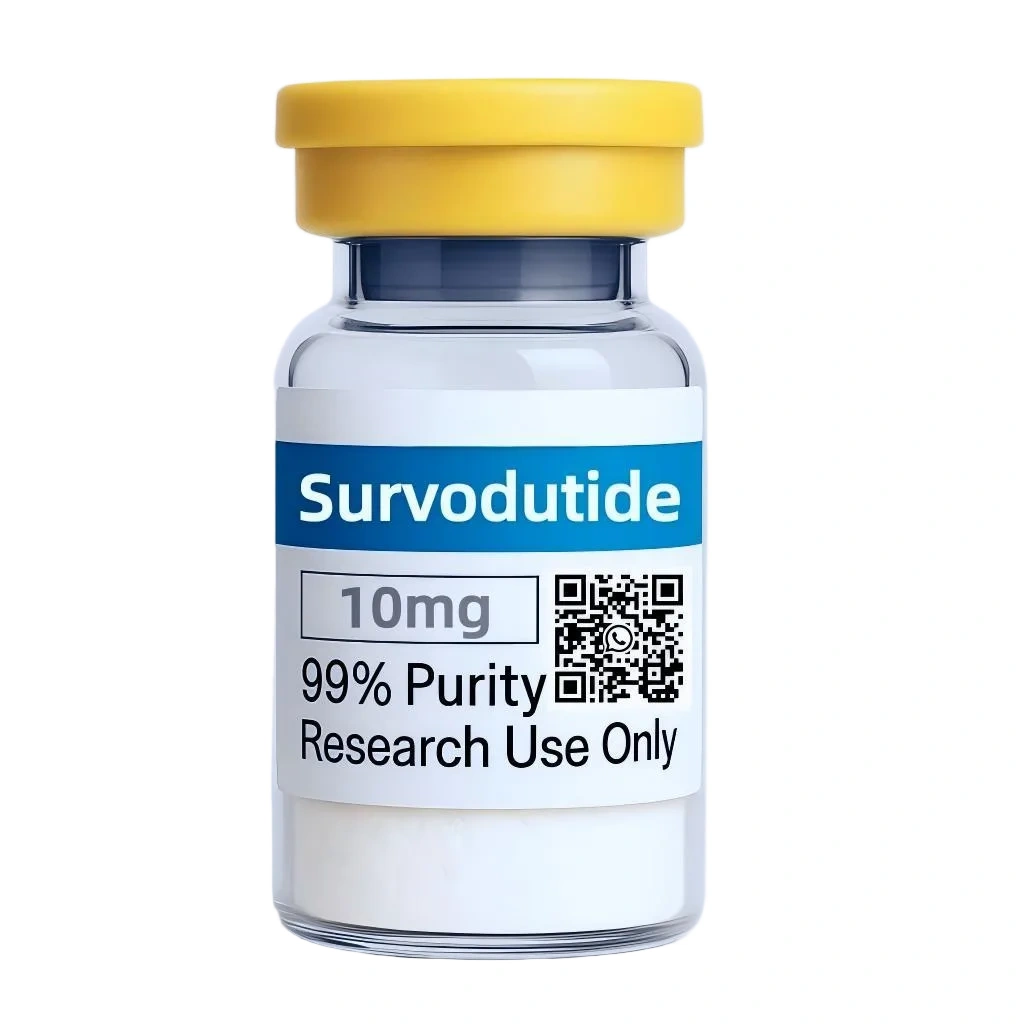
Survodutide GLP-1/glucagon receptor dual agonist research peptide. Sourced directly from China. Purity tested per batch, wholesale pricing.
Survodutide is a research compound available through our china peptide catalog as a finished, lyophilized vial from an established Chinese manufacturer. It belongs to the GLP-1/glucagon dual receptor agonist (unimolecular)
Research Areas
Hepatic metabolism, NASH/MASH research, metabolic disorders, dual-receptor pharmacology
Available Variants
| Name | Strength | Pack Size | Purity | Availability |
|---|---|---|---|---|
| Survodutide | 10 mg | 10 vials | ≥98% | In Stock |
Specification Highlights
Quality & Testing
Testing method: HPLC / LC-MS . Products are supplied against the specification shown on the applicable product page. The standard catalog purity specification is ≥98% unless otherwise stated. Product-specific specifications and quality-control information may vary by compound and batch. Every batch is tested by the manufacturer for purity and concentration as part of routine quality control, using methods such as HPLC and LC-MS. These results are kept in the manufacturer’s internal quality-control records and are not issued as a separate certificate or document.
Research Areas
GLP-1/Glucagon Dual Agonism Research into survodutide focuses on how simultaneous GLP-1R and GCGR activation affects metabolic outcomes compared to selective GLP-1R agonism alone. Glucagon receptor signaling promotes hepatic glycogenolysis and fat oxidation — typically viewed as counterproductive in metabolic disease — but in the context of caloric restriction and GLP-1-mediated insulin secretion, studies have examined whether glucagonergic input provides additive benefits to energy expenditure and hepatic lipid clearance. Hepatic Steatosis and MASH Research One of the primary research applications for survodutide is MASH (metabolic dysfunction-associated steatohepatitis), formerly NASH. Glucagon receptor activation’s ability to promote fatty acid oxidation in the liver has made dual GLP-1/glucagon agonists of particular interest in this indication. Preclinical studies have examined liver fat content reduction, inflammatory marker changes (AST, ALT), and fibrosis scoring in steatohepatitis models. Mechanistic Differentiation from GIP-Based Strategies Survodutide provides researchers with a mechanistic counterpart to GLP-1/GIP dual agonists. While GIP receptor activation primarily affects adipose tissue insulin sensitivity and incretin release, glucagon receptor activation has a distinct hepatocentric profile. Studies comparing GLP-1/GCGR versus GLP-1/GIPR strategies in matched preclinical models are of significant research interest for understanding organ-specific metabolic regulation. ## Sourcing Survodutide From China
Survodutide is available through our platform as a china peptide sourced directly from an established Chinese manufacturer. Three points define how we handle it:
- Factory-direct, not trader-sourced. We confirm availability and specification with the manufacturer before the order is confirmed. There is no intermediary resale of unknown-origin vials in this catalog.
- Specification before shipment. The purity and concentration specification shown on this page is the manufacturer’s batch specification. Product-specific quality-control information travels with the order.
- Research-use discipline. Like every listing in our catalog, Survodutide is supplied for laboratory research use only, under strict research-use terms.
For buyers comparing chinese peptides suppliers, the practical test is whether the seller can name the manufacturer and show the batch documentation. We work the other way around: the manufacturer and the documentation are the offer. Browse the full catalog or see how sourcing works.
Available Variants
| Name | Strength | Pack Size | Purity | Availability |
|---|---|---|---|---|
| Survodutide | 10 mg | 10 vials | ≥98% | In Stock |
Specification Highlights
Quality & Testing
Testing method: HPLC / LC-MS . Products are supplied against the specification shown on the applicable product page. The standard catalog purity specification is ≥98% unless otherwise stated. Product-specific specifications and quality-control information may vary by compound and batch. Every batch is tested by the manufacturer for purity and concentration as part of routine quality control, using methods such as HPLC and LC-MS. These results are kept in the manufacturer’s internal quality-control records and are not issued as a separate certificate or document.
Research Areas
GLP-1/Glucagon Dual Agonism Research into survodutide focuses on how simultaneous GLP-1R and GCGR activation affects metabolic outcomes compared to selective GLP-1R agonism alone. Glucagon receptor signaling promotes hepatic glycogenolysis and fat oxidation — typically viewed as counterproductive in metabolic disease — but in the context of caloric restriction and GLP-1-mediated insulin secretion, studies have examined whether glucagonergic input provides additive benefits to energy expenditure and hepatic lipid clearance. Hepatic Steatosis and MASH Research One of the primary research applications for survodutide is MASH (metabolic dysfunction-associated steatohepatitis), formerly NASH. Glucagon receptor activation’s ability to promote fatty acid oxidation in the liver has made dual GLP-1/glucagon agonists of particular interest in this indication. Preclinical studies have examined liver fat content reduction, inflammatory marker changes (AST, ALT), and fibrosis scoring in steatohepatitis models. Mechanistic Differentiation from GIP-Based Strategies Survodutide provides researchers with a mechanistic counterpart to GLP-1/GIP dual agonists. While GIP receptor activation primarily affects adipose tissue insulin sensitivity and incretin release, glucagon receptor activation has a distinct hepatocentric profile. Studies comparing GLP-1/GCGR versus GLP-1/GIPR strategies in matched preclinical models are of significant research interest for understanding organ-specific metabolic regulation.
Compound Profile
Survodutide (BI 456906) is a dual GLP-1/glucagon receptor co-agonist under clinical investigation, developed as a single peptide molecule with agonist activity at both the glucagon-like peptide-1 receptor (GLP-1R) and the glucagon receptor (GCGR). The compound’s pharmacological rationale differs from incretin-based approaches: glucagon receptor activation promotes hepatic fat oxidation and energy expenditure, while simultaneous GLP-1 receptor engagement provides satiety and insulin secretagogue effects — positioning the combination as a research tool for examining hepatic and systemic metabolic pathways simultaneously. Preclinical studies in rodent models of diet-induced obesity and non-alcoholic steatohepatitis (NASH) have examined survodutide’s effects on liver fat content, inflammatory markers, and fibrosis-related endpoints. GCGR activation distinguishes survodutide from GLP-1/GIP dual agonists such as tirzepatide, providing a distinct mechanistic lens for studying the glucagonergic contribution to hepatic metabolism — an area of particular interest in MASH (metabolic dysfunction-associated steatohepatitis) research. Peptides of China supplies survodutide as a lyophilized powder in sealed vials at 99%+ purity, verified by HPLC and Mass Spectrometry. Every batch is tested by the manufacturer for purity and concentration as part of routine quality control. All products are for laboratory research use only and are not for human consumption.
Profile
Research Areas
Hepatic metabolism, NASH/MASH research, metabolic disorders, dual-receptor pharmacology
Available Variants
| Name | Strength | Pack Size | Purity | Availability |
|---|---|---|---|---|
| Survodutide | 10 mg | 10 vials | ≥98% | In Stock |
Specification Highlights
Quality & Testing
Testing method: HPLC / LC-MS . Products are supplied against the specification shown on the applicable product page. The standard catalog purity specification is ≥98% unless otherwise stated. Product-specific specifications and quality-control information may vary by compound and batch. Every batch is tested by the manufacturer for purity and concentration as part of routine quality control, using methods such as HPLC and LC-MS. These results are kept in the manufacturer’s internal quality-control records and are not issued as a separate certificate or document.
Research Areas
GLP-1/Glucagon Dual Agonism Research into survodutide focuses on how simultaneous GLP-1R and GCGR activation affects metabolic outcomes compared to selective GLP-1R agonism alone. Glucagon receptor signaling promotes hepatic glycogenolysis and fat oxidation — typically viewed as counterproductive in metabolic disease — but in the context of caloric restriction and GLP-1-mediated insulin secretion, studies have examined whether glucagonergic input provides additive benefits to energy expenditure and hepatic lipid clearance. Hepatic Steatosis and MASH Research One of the primary research applications for survodutide is MASH (metabolic dysfunction-associated steatohepatitis), formerly NASH. Glucagon receptor activation’s ability to promote fatty acid oxidation in the liver has made dual GLP-1/glucagon agonists of particular interest in this indication. Preclinical studies have examined liver fat content reduction, inflammatory marker changes (AST, ALT), and fibrosis scoring in steatohepatitis models. Mechanistic Differentiation from GIP-Based Strategies Survodutide provides researchers with a mechanistic counterpart to GLP-1/GIP dual agonists. While GIP receptor activation primarily affects adipose tissue insulin sensitivity and incretin release, glucagon receptor activation has a distinct hepatocentric profile. Studies comparing GLP-1/GCGR versus GLP-1/GIPR strategies in matched preclinical models are of significant research interest for understanding organ-specific metabolic regulation.