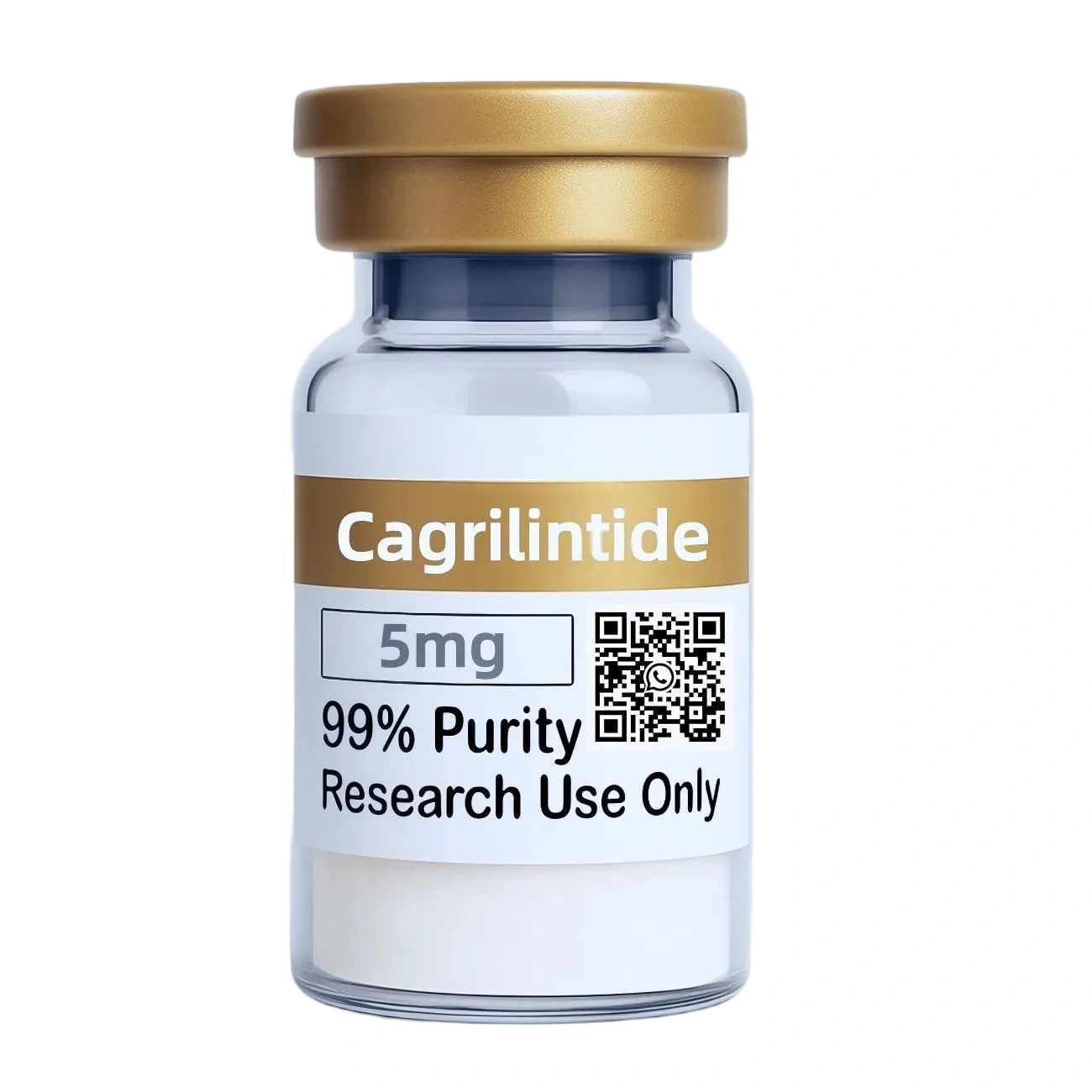
Cagrilintide research peptide sourced from verified Chinese synthesis facility. Long-acting amylin analog. Purity tested per batch, wholesale B2B pricing.
Cagrilintide is a research compound available through our china peptide catalog as a finished, lyophilized vial from an established Chinese manufacturer. It belongs to the Acylated amylin analogue
Research Areas
Metabolic regulation, appetite signaling, gastric emptying, amylin receptor pharmacology
Available Variants
| Name | Strength | Pack Size | Purity | Availability |
|---|---|---|---|---|
| Cagrilintide | 5 mg | 10 vials | ≥98% | In Stock |
| Cagrilintide | 5 mg | 10 vials | — | In Stock |
| Cagrilintide | 10 mg | 10 vials | ≥98% | In Stock |
| Cagrilintide | 10 mg | 10 vials | — | In Stock |
Specification Highlights
Quality & Testing
Testing method: HPLC / LC-MS ([“HPLC”,“LC-MS”,“Endotoxins”,“Microbiology”,“Water Content”]) . Products are supplied against the specification shown on the applicable product page. The standard catalog purity specification is ≥98% unless otherwise stated. Product-specific specifications and quality-control information may vary by compound and batch. Available documentation: .
**Where provided, these documents reflect the manufacturer’s batch testing for this compound.
Research Areas
Amylin Receptor Pharmacology Cagrilintide binds amylin receptor complexes (AMY1-3), which are heterodimers of the calcitonin receptor and receptor activity-modifying proteins (RAMPs). Research has focused on how fatty acid acylation affects receptor binding affinity, selectivity between AMY subtypes, and duration of action compared to native human amylin and earlier analogues. The long half-life achieved through acylation is a primary pharmacokinetic research interest. Energy Intake and Satiety Signaling Studies have examined cagrilintide’s effects on food intake in diet-induced obesity rodent models. Proposed mechanisms include signaling through hindbrain amylin receptors in the area postrema and nucleus tractus solitarius, regions involved in satiety processing. Complementary action with GLP-1 receptor agonists at distinct central sites has been a key hypothesis driving combination research. Metabolic Parameter Research Research has examined cagrilintide’s influence on gastric emptying, glucagon secretion, and body weight outcomes in preclinical models. Its metabolic profile — distinct from GLP-1, GIP, or glucagon receptor pathways — positions it as a tool compound for studying amylinergic contributions to energy homeostasis independent of incretin signaling. ## Sourcing Cagrilintide From China
Cagrilintide is available through our platform as a china peptide sourced directly from an established Chinese manufacturer. Three points define how we handle it:
- Factory-direct, not trader-sourced. We confirm availability and specification with the manufacturer before the order is confirmed. There is no intermediary resale of unknown-origin vials in this catalog.
- Specification before shipment. The purity and concentration specification shown on this page is the manufacturer’s batch specification. Product-specific quality-control information travels with the order.
- Research-use discipline. Like every listing in our catalog, Cagrilintide is supplied for laboratory research use only, under strict research-use terms.
For buyers comparing chinese peptides suppliers, the practical test is whether the seller can name the manufacturer and show the batch documentation. We work the other way around: the manufacturer and the documentation are the offer. Browse the full catalog or see how sourcing works.
Available Variants
| Name | Strength | Pack Size | Purity | Availability |
|---|---|---|---|---|
| Cagrilintide | 5 mg | 10 vials | ≥98% | In Stock |
| Cagrilintide | 5 mg | 10 vials | — | In Stock |
| Cagrilintide | 10 mg | 10 vials | ≥98% | In Stock |
| Cagrilintide | 10 mg | 10 vials | — | In Stock |
Specification Highlights
Quality & Testing
Testing method: HPLC / LC-MS ([“HPLC”,“LC-MS”,“Endotoxins”,“Microbiology”,“Water Content”]) . Products are supplied against the specification shown on the applicable product page. The standard catalog purity specification is ≥98% unless otherwise stated. Product-specific specifications and quality-control information may vary by compound and batch. Available documentation: .
**Where provided, these documents reflect the manufacturer’s batch testing for this compound.
Research Areas
Amylin Receptor Pharmacology Cagrilintide binds amylin receptor complexes (AMY1-3), which are heterodimers of the calcitonin receptor and receptor activity-modifying proteins (RAMPs). Research has focused on how fatty acid acylation affects receptor binding affinity, selectivity between AMY subtypes, and duration of action compared to native human amylin and earlier analogues. The long half-life achieved through acylation is a primary pharmacokinetic research interest. Energy Intake and Satiety Signaling Studies have examined cagrilintide’s effects on food intake in diet-induced obesity rodent models. Proposed mechanisms include signaling through hindbrain amylin receptors in the area postrema and nucleus tractus solitarius, regions involved in satiety processing. Complementary action with GLP-1 receptor agonists at distinct central sites has been a key hypothesis driving combination research. Metabolic Parameter Research Research has examined cagrilintide’s influence on gastric emptying, glucagon secretion, and body weight outcomes in preclinical models. Its metabolic profile — distinct from GLP-1, GIP, or glucagon receptor pathways — positions it as a tool compound for studying amylinergic contributions to energy homeostasis independent of incretin signaling.
Compound Profile
Cagrilintide is a long-acting acylated amylin analogue developed for metabolic research. Structurally derived from human amylin (IAPP — islet amyloid polypeptide), it is modified with a C20 fatty diacid chain to extend its plasma half-life to approximately 7 days, enabling once-weekly administration in clinical protocols. Research interest centers on its action at amylin receptors (AMY1, AMY2, AMY3) in the hypothalamus and area postrema, which are distinct from the GLP-1 receptor pathway targeted by semaglutide and related compounds. Preclinical and early clinical studies have examined cagrilintide’s role in energy intake regulation, gastric emptying rate, and glucagon suppression. Unlike GLP-1 receptor agonists, amylin analogues appear to act via complementary central pathways, with satiety signals mediated through hindbrain amylin receptor populations. This mechanistic distinction has generated research interest in dual-agonism approaches combining amylin and GLP-1 receptor activity — most notably in the CagriSema combination, currently in phase 3 clinical evaluation. Peptides of China supplies cagrilintide as a lyophilized powder in sealed vials at 99%+ purity, verified by HPLC and Mass Spectrometry. Every batch is tested by the manufacturer for purity and concentration as part of routine quality control. All products are supplied for laboratory research use only and are not for human consumption.
Profile
Research Areas
Metabolic regulation, appetite signaling, gastric emptying, amylin receptor pharmacology
Available Variants
| Name | Strength | Pack Size | Purity | Availability |
|---|---|---|---|---|
| Cagrilintide | 5 mg | 10 vials | ≥98% | In Stock |
| Cagrilintide | 5 mg | 10 vials | — | In Stock |
| Cagrilintide | 10 mg | 10 vials | ≥98% | In Stock |
| Cagrilintide | 10 mg | 10 vials | — | In Stock |
Specification Highlights
Quality & Testing
Testing method: HPLC / LC-MS ([“HPLC”,“LC-MS”,“Endotoxins”,“Microbiology”,“Water Content”]) . Products are supplied against the specification shown on the applicable product page. The standard catalog purity specification is ≥98% unless otherwise stated. Product-specific specifications and quality-control information may vary by compound and batch. Available documentation: .
**Where provided, these documents reflect the manufacturer’s batch testing for this compound.
Research Areas
Amylin Receptor Pharmacology Cagrilintide binds amylin receptor complexes (AMY1-3), which are heterodimers of the calcitonin receptor and receptor activity-modifying proteins (RAMPs). Research has focused on how fatty acid acylation affects receptor binding affinity, selectivity between AMY subtypes, and duration of action compared to native human amylin and earlier analogues. The long half-life achieved through acylation is a primary pharmacokinetic research interest. Energy Intake and Satiety Signaling Studies have examined cagrilintide’s effects on food intake in diet-induced obesity rodent models. Proposed mechanisms include signaling through hindbrain amylin receptors in the area postrema and nucleus tractus solitarius, regions involved in satiety processing. Complementary action with GLP-1 receptor agonists at distinct central sites has been a key hypothesis driving combination research. Metabolic Parameter Research Research has examined cagrilintide’s influence on gastric emptying, glucagon secretion, and body weight outcomes in preclinical models. Its metabolic profile — distinct from GLP-1, GIP, or glucagon receptor pathways — positions it as a tool compound for studying amylinergic contributions to energy homeostasis independent of incretin signaling.