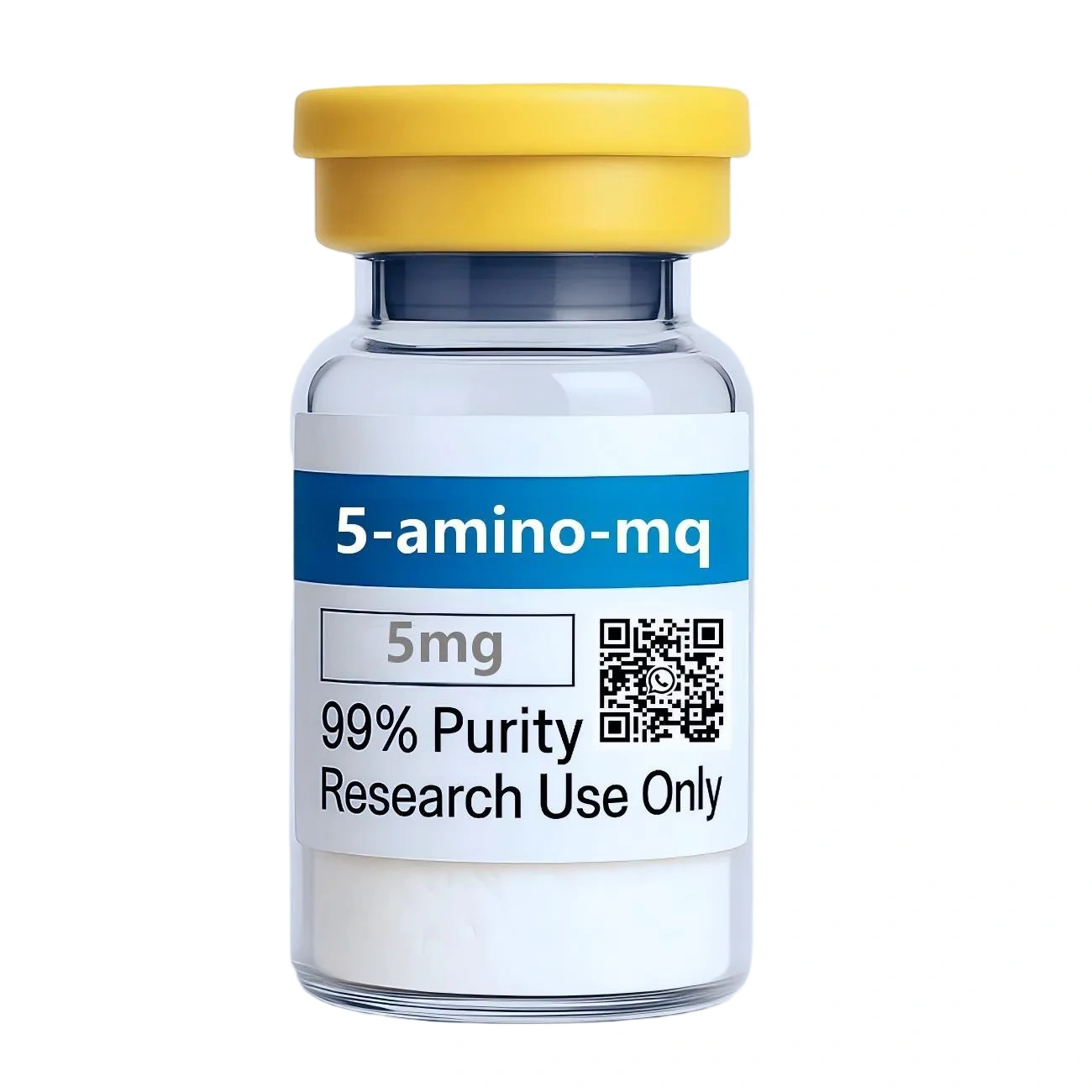
5-Amino-1MQ NNMT inhibitor small molecule for metabolic research. Sourced from verified Chinese manufacturer. Purity tested per batch.
5-Amino-1MQ is a research compound available through our china peptide catalog as a finished, lyophilized vial from an established Chinese manufacturer. It belongs to the Methylquinolinium NNMT inhibitor (small molecule)
Research Areas
NNMT biology, adipose tissue epigenetics, SAM-dependent methylation, obesity models, NAD⁺ precursor metabolism
Available Variants
| Name | Strength | Pack Size | Purity | Availability |
|---|---|---|---|---|
| 5-Amino-1MQ | 5 mg | 10 vials | ≥98% | In Stock |
| 5-Amino-1MQ | 10 mg | 10 vials | ≥98% | In Stock |
| 5-Amino-1MQ | 50 mg | 10 vials | ≥98% | In Stock |
| 5-Amino-1MQ | 50 mg | 10 vials | — | In Stock |
Specification Highlights
Quality & Testing
Testing method: HPLC / LC-MS . Products are supplied against the specification shown on the applicable product page. The standard catalog purity specification is ≥98% unless otherwise stated. Product-specific specifications and quality-control information may vary by compound and batch. Every batch is tested by the manufacturer for purity and concentration as part of routine quality control, using methods such as HPLC and LC-MS. These results are kept in the manufacturer’s internal quality-control records and are not issued as a separate certificate or document.
Research Areas
NNMT Inhibition and Adipose Biology NNMT is highly expressed in adipose tissue and upregulated in obesity, where it consumes nicotinamide (vitamin B3) and SAM. Research has used 5-Amino-1MQ to examine how NNMT inhibition affects adipocyte differentiation, lipid droplet accumulation, and adipogenic transcription factor activity (PPAR-γ, C/EBPα) in cell culture and rodent models. The working hypothesis is that NNMT inhibition preserves SAM for epigenetic H3K4 methylation events that suppress adipogenic programming. SAM Methylation Economy Research NNMT consumes SAM — the universal methyl donor for DNA and histone methyltransferases — converting it to S-adenosylhomocysteine while methylating nicotinamide. Research has examined how 5-Amino-1MQ-mediated NNMT inhibition affects cellular SAM/SAH ratios, global histone methylation patterns, and gene expression programs regulated by SAM-dependent methylation. This positions 5-Amino-1MQ as a tool for studying the interface between one-carbon metabolism and epigenetic regulation. NAD⁺ Precursor Flux Research By inhibiting NNMT, 5-Amino-1MQ preserves nicotinamide for NAD⁺ biosynthesis via the NAMPT pathway rather than diverting it to 1-methylnicotinamide. Research has examined whether this shift in nicotinamide flux increases cellular NAD⁺ levels and downstream sirtuin (SIRT1/3) activity — connecting NNMT biology to the growing field of NAD⁺ metabolism and longevity research. ## Sourcing 5-Amino-1MQ From China
5-Amino-1MQ is available through our platform as a china peptide sourced directly from an established Chinese manufacturer. Three points define how we handle it:
- Factory-direct, not trader-sourced. We confirm availability and specification with the manufacturer before the order is confirmed. There is no intermediary resale of unknown-origin vials in this catalog.
- Specification before shipment. The purity and concentration specification shown on this page is the manufacturer’s batch specification. Product-specific quality-control information travels with the order.
- Research-use discipline. Like every listing in our catalog, 5-Amino-1MQ is supplied for laboratory research use only, under strict research-use terms.
For buyers comparing chinese peptides suppliers, the practical test is whether the seller can name the manufacturer and show the batch documentation. We work the other way around: the manufacturer and the documentation are the offer. Browse the full catalog or see how sourcing works.
Available Variants
| Name | Strength | Pack Size | Purity | Availability |
|---|---|---|---|---|
| 5-Amino-1MQ | 5 mg | 10 vials | ≥98% | In Stock |
| 5-Amino-1MQ | 10 mg | 10 vials | ≥98% | In Stock |
| 5-Amino-1MQ | 50 mg | 10 vials | ≥98% | In Stock |
| 5-Amino-1MQ | 50 mg | 10 vials | — | In Stock |
Specification Highlights
Quality & Testing
Testing method: HPLC / LC-MS . Products are supplied against the specification shown on the applicable product page. The standard catalog purity specification is ≥98% unless otherwise stated. Product-specific specifications and quality-control information may vary by compound and batch. Every batch is tested by the manufacturer for purity and concentration as part of routine quality control, using methods such as HPLC and LC-MS. These results are kept in the manufacturer’s internal quality-control records and are not issued as a separate certificate or document.
Research Areas
NNMT Inhibition and Adipose Biology NNMT is highly expressed in adipose tissue and upregulated in obesity, where it consumes nicotinamide (vitamin B3) and SAM. Research has used 5-Amino-1MQ to examine how NNMT inhibition affects adipocyte differentiation, lipid droplet accumulation, and adipogenic transcription factor activity (PPAR-γ, C/EBPα) in cell culture and rodent models. The working hypothesis is that NNMT inhibition preserves SAM for epigenetic H3K4 methylation events that suppress adipogenic programming. SAM Methylation Economy Research NNMT consumes SAM — the universal methyl donor for DNA and histone methyltransferases — converting it to S-adenosylhomocysteine while methylating nicotinamide. Research has examined how 5-Amino-1MQ-mediated NNMT inhibition affects cellular SAM/SAH ratios, global histone methylation patterns, and gene expression programs regulated by SAM-dependent methylation. This positions 5-Amino-1MQ as a tool for studying the interface between one-carbon metabolism and epigenetic regulation. NAD⁺ Precursor Flux Research By inhibiting NNMT, 5-Amino-1MQ preserves nicotinamide for NAD⁺ biosynthesis via the NAMPT pathway rather than diverting it to 1-methylnicotinamide. Research has examined whether this shift in nicotinamide flux increases cellular NAD⁺ levels and downstream sirtuin (SIRT1/3) activity — connecting NNMT biology to the growing field of NAD⁺ metabolism and longevity research.
Profile
Research Areas
NNMT biology, adipose tissue epigenetics, SAM-dependent methylation, obesity models, NAD⁺ precursor metabolism
Available Variants
| Name | Strength | Pack Size | Purity | Availability |
|---|---|---|---|---|
| 5-Amino-1MQ | 5 mg | 10 vials | ≥98% | In Stock |
| 5-Amino-1MQ | 10 mg | 10 vials | ≥98% | In Stock |
| 5-Amino-1MQ | 50 mg | 10 vials | ≥98% | In Stock |
| 5-Amino-1MQ | 50 mg | 10 vials | — | In Stock |
Specification Highlights
Quality & Testing
Testing method: HPLC / LC-MS . Products are supplied against the specification shown on the applicable product page. The standard catalog purity specification is ≥98% unless otherwise stated. Product-specific specifications and quality-control information may vary by compound and batch. Every batch is tested by the manufacturer for purity and concentration as part of routine quality control, using methods such as HPLC and LC-MS. These results are kept in the manufacturer’s internal quality-control records and are not issued as a separate certificate or document.
Research Areas
NNMT Inhibition and Adipose Biology NNMT is highly expressed in adipose tissue and upregulated in obesity, where it consumes nicotinamide (vitamin B3) and SAM. Research has used 5-Amino-1MQ to examine how NNMT inhibition affects adipocyte differentiation, lipid droplet accumulation, and adipogenic transcription factor activity (PPAR-γ, C/EBPα) in cell culture and rodent models. The working hypothesis is that NNMT inhibition preserves SAM for epigenetic H3K4 methylation events that suppress adipogenic programming. SAM Methylation Economy Research NNMT consumes SAM — the universal methyl donor for DNA and histone methyltransferases — converting it to S-adenosylhomocysteine while methylating nicotinamide. Research has examined how 5-Amino-1MQ-mediated NNMT inhibition affects cellular SAM/SAH ratios, global histone methylation patterns, and gene expression programs regulated by SAM-dependent methylation. This positions 5-Amino-1MQ as a tool for studying the interface between one-carbon metabolism and epigenetic regulation. NAD⁺ Precursor Flux Research By inhibiting NNMT, 5-Amino-1MQ preserves nicotinamide for NAD⁺ biosynthesis via the NAMPT pathway rather than diverting it to 1-methylnicotinamide. Research has examined whether this shift in nicotinamide flux increases cellular NAD⁺ levels and downstream sirtuin (SIRT1/3) activity — connecting NNMT biology to the growing field of NAD⁺ metabolism and longevity research.