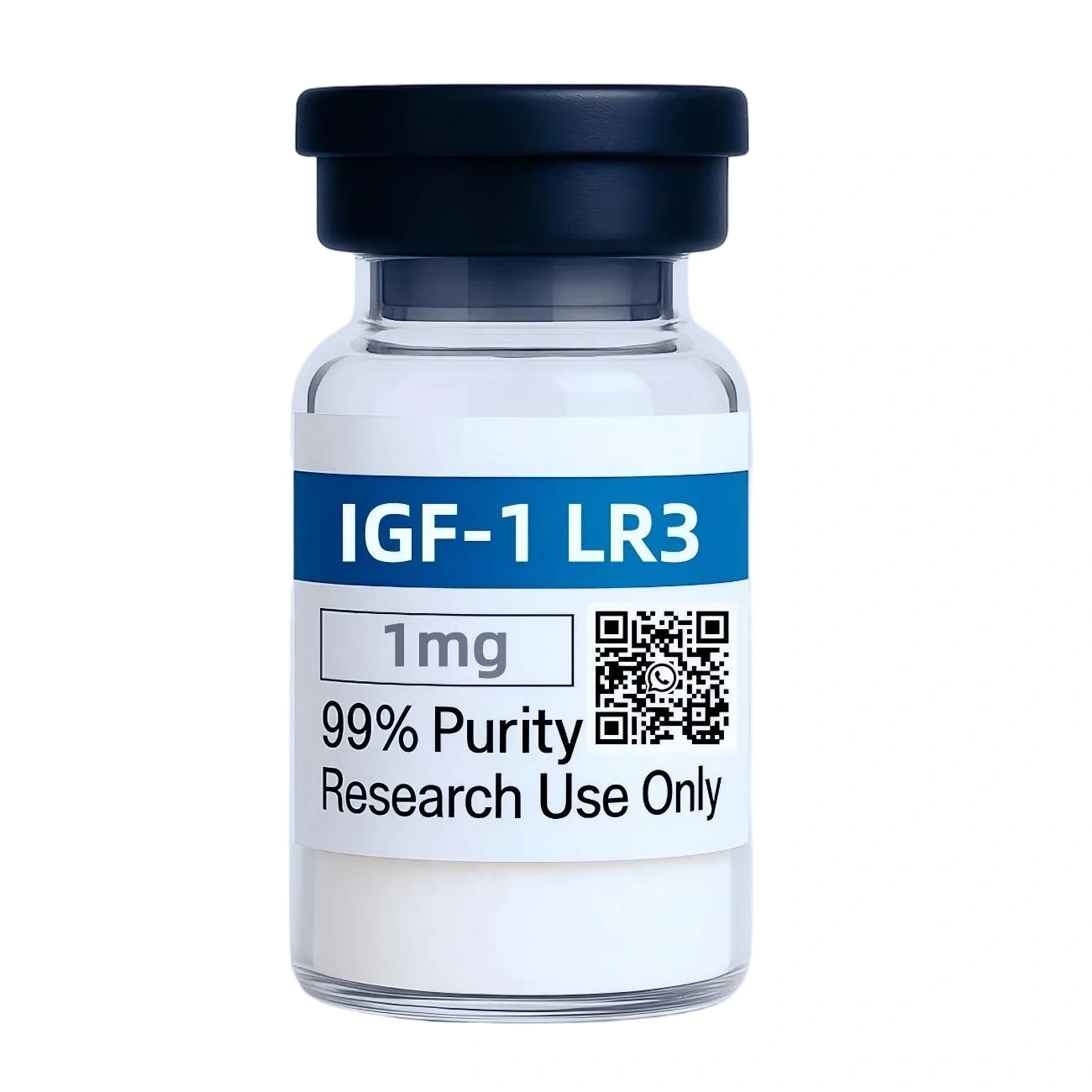
IGF-1 LR3 long-acting insulin-like growth factor research peptide. Sourced from verified Chinese manufacturer. Purity tested per batch.
IGF-1 LR3 is a research compound available through our china peptide catalog as a finished, lyophilized vial from an established Chinese manufacturer. It belongs to the Long-acting IGF-1 Analogue / Recombinant Peptide Full Name Long Arg3 Insulin-like Growth Factor-I
Available Variants
| Name | Strength | Pack Size | Purity | Availability |
|---|---|---|---|---|
| 68.00 IGF-1 LR3 | 1 mg | 10 vials | ≥98% | Out of Stock |
| IGF-1 LR3 | 1 mg | 10 vials | — | In Stock |
Specification Highlights
Variant Notes
Modified analogue of insulin-like growth factor IGF-1 with reduced affinity for IGF-binding proteins. Used in studies of IGF receptor signalling, cell proliferation, and regulation of protein synthesis.
Research Areas
IGF-1 Receptor Signalling Research IGF-1 LR3 is the standard tool compound for sustained IGF-1R activation in cell-based studies. Downstream signalling endpoints — PI3K/Akt/mTOR, MAPK/ERK — are characterised using phosphoproteomics, Western blotting, and proximity ligation assays. The compound’s IGFBP-resistance removes the confound of IGFBP-3 and IGFBP-5 competitive inhibition present in serum-containing culture conditions, making dose-response relationships more reproducible than with native IGF-1. IGF-1R knockout cell lines and blocking antibodies (αIR3) are used alongside IGF-1 LR3 to confirm receptor specificity. Skeletal Muscle & Anabolic Research IGF-1 and IGF-1R signalling are central to skeletal muscle hypertrophy, satellite cell activation, and atrophy resistance. C2C12 myoblast differentiation assays (myotube fusion index, myosin heavy chain expression) and primary mouse satellite cell cultures are standard formats for characterising IGF-1 LR3’s myogenic effects. In vivo, rodent hindlimb unloading models (muscle atrophy from immobilisation) use IGF-1 LR3 to test whether IGF-1R activation preserves muscle mass and force output — mechanistically relevant to research on sarcopenia and disuse atrophy. Cell Culture Media Optimisation IGF-1 LR3 is widely used as a recombinant serum substitute in cell culture media formulations. CHO, BHK, HEK293, and hybridoma cell lines supplemented with IGF-1 LR3 in defined or low-serum media show improved viability, proliferation, and biologic production yields. The LR3 form is preferred over native IGF-1 because its IGFBP resistance results in more consistent bioavailability in conditioned media — native IGF-1 is partially sequestered by secreted IGFBPs in conditioned medium, causing variable effective concentrations between experiments. Bone & Cartilage Biology IGF-1 signalling is required for longitudinal bone growth and periosteal apposition during development, and for maintenance of bone mineral density in adults. In vitro models using primary osteoblasts, osteoblast-like cell lines (MC3T3-E1, Saos-2), and ex vivo fetal long bone cultures characterise IGF-1 LR3’s effects on osteoblast proliferation, alkaline phosphatase activity, and mineralisation kinetics. Chondrocyte models (ATDC5, primary articular chondrocytes) use IGF-1 LR3 in studies of cartilage matrix synthesis and the IGF-1/IGFBP axis in osteoarthritis. ## Sourcing IGF-1 LR3 From China
IGF-1 LR3 is available through our platform as a china peptide sourced directly from an established Chinese manufacturer. Three points define how we handle it:
- Factory-direct, not trader-sourced. We confirm availability and specification with the manufacturer before the order is confirmed. There is no intermediary resale of unknown-origin vials in this catalog.
- Specification before shipment. The purity and concentration specification shown on this page is the manufacturer’s batch specification. Product-specific quality-control information travels with the order.
- Research-use discipline. Like every listing in our catalog, IGF-1 LR3 is supplied for laboratory research use only, under strict research-use terms.
For buyers comparing chinese peptides suppliers, the practical test is whether the seller can name the manufacturer and show the batch documentation. We work the other way around: the manufacturer and the documentation are the offer. Browse the full catalog or see how sourcing works.
Compound Profile
IGF-1 LR3 (Long Arg3 Insulin-like Growth Factor-I) is a recombinant 83-amino acid analogue of human IGF-1, extended by a 13-residue N-terminal sequence and containing a glutamate-to-arginine substitution at position 3 (Glu³→Arg³). This two-part structural modification produces a dramatic reduction in IGF-binding protein (IGFBP) affinity — approximately 2–3 orders of magnitude lower than native IGF-1 — while retaining full IGF-1 receptor (IGF-1R) binding and activation. Since IGFBPs sequester the majority of circulating IGF-1 in vivo (only ~1% is free at any time), the reduced IGFBP affinity of LR3 translates to a substantially greater proportion of free, bioactive peptide per administered dose. This property makes IGF-1 LR3 the standard IGF-1 variant used in most cell biology and animal pharmacology research where systemic IGF-1 activity is the research endpoint. The extended half-life of IGF-1 LR3 in vivo — approximately 20–30 hours compared to 12–15 minutes for native IGF-1 — results directly from the reduced IGFBP buffering. This makes it a valuable tool in studies examining the chronic anabolic and mitogenic effects of IGF-1R activation across tissues including skeletal muscle, bone, liver, and the central nervous system. IGF-1 LR3 is widely used in cell culture research as a growth factor supplement and in defined-serum conditions where endogenous growth factor concentrations must be controlled — particularly in hybridoma, CHO, and stem cell culture protocols where it partially replaces serum-derived IGF-1. Peptides of China supplies IGF-1 LR3 as lyophilized powder at ≥98% purity, verified by HPLC and confirmed by mass spectrometry. Certificates of Analysis available per batch. Wholesale quantities available on request. This compound is for laboratory research use only.
Profile
Available Variants
| Name | Strength | Pack Size | Purity | Availability |
|---|---|---|---|---|
| 68.00 IGF-1 LR3 | 1 mg | 10 vials | ≥98% | Out of Stock |
| IGF-1 LR3 | 1 mg | 10 vials | — | In Stock |
Specification Highlights
Variant Notes
Modified analogue of insulin-like growth factor IGF-1 with reduced affinity for IGF-binding proteins. Used in studies of IGF receptor signalling, cell proliferation, and regulation of protein synthesis.
Research Areas
IGF-1 Receptor Signalling Research IGF-1 LR3 is the standard tool compound for sustained IGF-1R activation in cell-based studies. Downstream signalling endpoints — PI3K/Akt/mTOR, MAPK/ERK — are characterised using phosphoproteomics, Western blotting, and proximity ligation assays. The compound’s IGFBP-resistance removes the confound of IGFBP-3 and IGFBP-5 competitive inhibition present in serum-containing culture conditions, making dose-response relationships more reproducible than with native IGF-1. IGF-1R knockout cell lines and blocking antibodies (αIR3) are used alongside IGF-1 LR3 to confirm receptor specificity. Skeletal Muscle & Anabolic Research IGF-1 and IGF-1R signalling are central to skeletal muscle hypertrophy, satellite cell activation, and atrophy resistance. C2C12 myoblast differentiation assays (myotube fusion index, myosin heavy chain expression) and primary mouse satellite cell cultures are standard formats for characterising IGF-1 LR3’s myogenic effects. In vivo, rodent hindlimb unloading models (muscle atrophy from immobilisation) use IGF-1 LR3 to test whether IGF-1R activation preserves muscle mass and force output — mechanistically relevant to research on sarcopenia and disuse atrophy. Cell Culture Media Optimisation IGF-1 LR3 is widely used as a recombinant serum substitute in cell culture media formulations. CHO, BHK, HEK293, and hybridoma cell lines supplemented with IGF-1 LR3 in defined or low-serum media show improved viability, proliferation, and biologic production yields. The LR3 form is preferred over native IGF-1 because its IGFBP resistance results in more consistent bioavailability in conditioned media — native IGF-1 is partially sequestered by secreted IGFBPs in conditioned medium, causing variable effective concentrations between experiments. Bone & Cartilage Biology IGF-1 signalling is required for longitudinal bone growth and periosteal apposition during development, and for maintenance of bone mineral density in adults. In vitro models using primary osteoblasts, osteoblast-like cell lines (MC3T3-E1, Saos-2), and ex vivo fetal long bone cultures characterise IGF-1 LR3’s effects on osteoblast proliferation, alkaline phosphatase activity, and mineralisation kinetics. Chondrocyte models (ATDC5, primary articular chondrocytes) use IGF-1 LR3 in studies of cartilage matrix synthesis and the IGF-1/IGFBP axis in osteoarthritis.