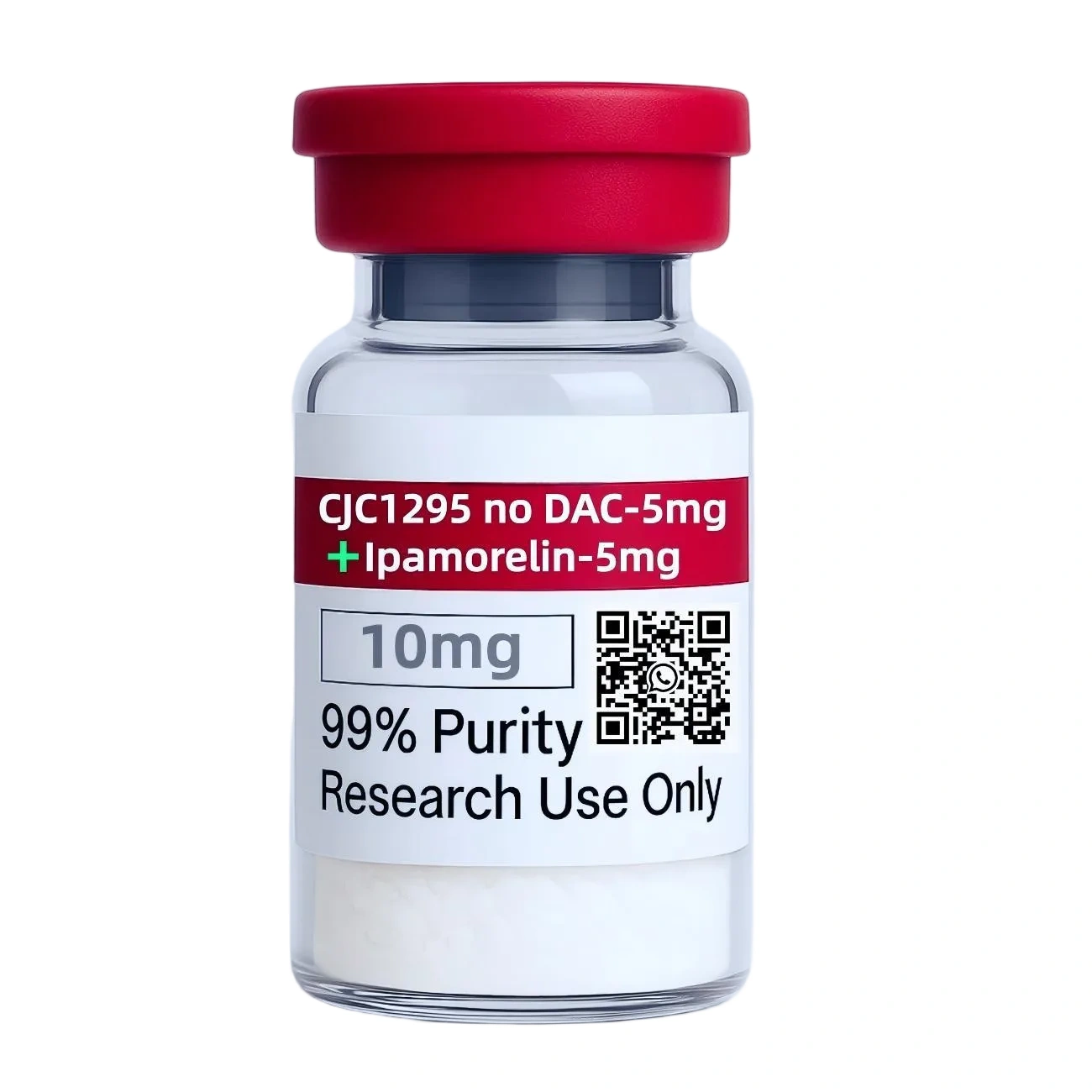
CJC-1295 and Ipamorelin combined blend. Sourced from verified Chinese manufacturer. HPLC verified, purity tested per batch. Research use only.
CJC-1295 + Ipamorelin is listed in our china peptide catalog as a finished research compound from an established Chinese manufacturer. It is catalogued under the Muscle & Performance, Hormonal Regulation, Blends
Variant Notes
GHRH/GHRP combination researched for synergistic effects on pulsatile growth hormone secretion. Commonly used in GH axis research protocols.
Research Areas
GHRHR + GHS-R1a Synergy Research The central research question for the CJC-1295/Ipamorelin combination is whether dual pathway engagement at GHRHR and GHS-R1a produces additive or synergistic GH release. Studies in rodent pituitary cell cultures and intact animal models have documented GH peak concentrations exceeding the sum of individual compound effects — consistent with a synergistic interaction between cAMP and PLC signaling cascades within somatotroph cells. This synergy is a model system for studying receptor crosstalk in endocrine pharmacology. GH Pulse Architecture Studies Research has characterized the GH pulse profiles produced by the combination versus each agent alone, examining peak amplitude, pulse duration, and inter-pulse interval. CJC-1295’s 30-minute half-life produces a defined stimulation window, while Ipamorelin’s GHS-R1a activity amplifies the somatotroph response within that window. This defined pharmacokinetic-pharmacodynamic relationship makes the combination a useful tool for studying GH pulse physiology under controlled conditions. IGF-1 Downstream Effects In vivo rodent research has examined downstream IGF-1 responses following CJC-1295/Ipamorelin co-administration, including hepatic IGF-1 production, circulating IGF-1 concentrations, and IGF-1-responsive tissue endpoints. The combination’s ability to produce consistent GH pulses in aged rodent models — where endogenous GH secretion is blunted — has made it a tool for studying GH axis restoration and IGF-1 dynamics in aging research. ## Sourcing CJC-1295 + Ipamorelin From China
CJC-1295 + Ipamorelin is available through our platform as a china peptide sourced directly from an established Chinese manufacturer. Three points define how we handle it:
- Factory-direct, not trader-sourced. We confirm availability and specification with the manufacturer before the order is confirmed. There is no intermediary resale of unknown-origin vials in this catalog.
- Specification before shipment. The purity and concentration specification shown on this page is the manufacturer’s batch specification. Product-specific quality-control information travels with the order.
- Research-use discipline. Like every listing in our catalog, CJC-1295 + Ipamorelin is supplied for laboratory research use only, under strict research-use terms.
For buyers comparing chinese peptides suppliers, the practical test is whether the seller can name the manufacturer and show the batch documentation. We work the other way around: the manufacturer and the documentation are the offer. Browse the full catalog or see how sourcing works.
Available Variants
| Name | Strength | Pack Size | Purity | Availability |
|---|---|---|---|---|
| CJC-1295 Without DAC + Ipamorelin | 10 + 10 mg | 10 vials | — | In Stock |
| CJC-1295 Without DAC 5mg + Ipamorelin 5mg | 10 mg | 10 vials | ≥98% | In Stock |
Specification Highlights
Variant Notes
GHRH/GHRP combination researched for synergistic effects on pulsatile growth hormone secretion. Commonly used in GH axis research protocols.
Research Areas
GHRHR + GHS-R1a Synergy Research The central research question for the CJC-1295/Ipamorelin combination is whether dual pathway engagement at GHRHR and GHS-R1a produces additive or synergistic GH release. Studies in rodent pituitary cell cultures and intact animal models have documented GH peak concentrations exceeding the sum of individual compound effects — consistent with a synergistic interaction between cAMP and PLC signaling cascades within somatotroph cells. This synergy is a model system for studying receptor crosstalk in endocrine pharmacology. GH Pulse Architecture Studies Research has characterized the GH pulse profiles produced by the combination versus each agent alone, examining peak amplitude, pulse duration, and inter-pulse interval. CJC-1295’s 30-minute half-life produces a defined stimulation window, while Ipamorelin’s GHS-R1a activity amplifies the somatotroph response within that window. This defined pharmacokinetic-pharmacodynamic relationship makes the combination a useful tool for studying GH pulse physiology under controlled conditions. IGF-1 Downstream Effects In vivo rodent research has examined downstream IGF-1 responses following CJC-1295/Ipamorelin co-administration, including hepatic IGF-1 production, circulating IGF-1 concentrations, and IGF-1-responsive tissue endpoints. The combination’s ability to produce consistent GH pulses in aged rodent models — where endogenous GH secretion is blunted — has made it a tool for studying GH axis restoration and IGF-1 dynamics in aging research.
Compound Profile
The CJC-1295 / Ipamorelin combination is the most widely studied GH secretagogue co-administration protocol in preclinical research. The two compounds act at distinct, mechanistically complementary receptors: CJC-1295 (modified GRF 1-29) targets the GHRH receptor (GHRHR) on anterior pituitary somatotrophs, while Ipamorelin targets the ghrelin receptor (GHS-R1a) at both pituitary and hypothalamic levels. Simultaneous engagement of both receptor systems produces synergistic GH pulse amplification that exceeds what either agent achieves alone — a well-characterized finding in rodent pituitary research models. Research interest in this combination centers on the mechanistic synergy between GHRHR and GHS-R1a pathways. At the cellular level, GHRHR signals via Gs-cAMP-PKA, while GHS-R1a signals via Gq-PLC-PKC; dual activation of both pathways within the same somatotroph cell is hypothesized to produce multiplicative rather than additive GH exocytosis. Ipamorelin’s selectivity profile — high GH specificity with minimal cortisol, prolactin, or FSH stimulation at research doses — makes it a preferred GHS-R1a agonist for combination protocols where minimizing off-target secretagogue effects is important. Peptides of China supplies CJC-1295 (without DAC) and Ipamorelin as separate lyophilized powders, allowing custom ratio formulation, as well as pre-combined vials for standardized research protocols. Both components are at 99%+ purity, verified by HPLC and Mass Spectrometry. All products are for laboratory research use only and are not for human consumption.
Profile
Combination Components CJC-1295 without DAC (Modified GRF 1-29) + Ipamorelin Receptor Targets GHRHR (CJC-1295) + GHS-R1a (Ipamorelin) Signaling Pathways Gs-cAMP-PKA (GHRHR) + Gq-PLC-PKC (GHS-R1a)
Research Areas
GH axis pharmacology, pituitary synergy research, GH pulse architecture, IGF-1 regulation Administration Form Separate lyophilized powders or pre-combined vials
Available Variants
| Name | Strength | Pack Size | Purity | Availability |
|---|---|---|---|---|
| CJC-1295 Without DAC + Ipamorelin | 10 + 10 mg | 10 vials | — | In Stock |
| CJC-1295 Without DAC 5mg + Ipamorelin 5mg | 10 mg | 10 vials | ≥98% | In Stock |
Specification Highlights
Variant Notes
GHRH/GHRP combination researched for synergistic effects on pulsatile growth hormone secretion. Commonly used in GH axis research protocols.
Research Areas
GHRHR + GHS-R1a Synergy Research The central research question for the CJC-1295/Ipamorelin combination is whether dual pathway engagement at GHRHR and GHS-R1a produces additive or synergistic GH release. Studies in rodent pituitary cell cultures and intact animal models have documented GH peak concentrations exceeding the sum of individual compound effects — consistent with a synergistic interaction between cAMP and PLC signaling cascades within somatotroph cells. This synergy is a model system for studying receptor crosstalk in endocrine pharmacology. GH Pulse Architecture Studies Research has characterized the GH pulse profiles produced by the combination versus each agent alone, examining peak amplitude, pulse duration, and inter-pulse interval. CJC-1295’s 30-minute half-life produces a defined stimulation window, while Ipamorelin’s GHS-R1a activity amplifies the somatotroph response within that window. This defined pharmacokinetic-pharmacodynamic relationship makes the combination a useful tool for studying GH pulse physiology under controlled conditions. IGF-1 Downstream Effects In vivo rodent research has examined downstream IGF-1 responses following CJC-1295/Ipamorelin co-administration, including hepatic IGF-1 production, circulating IGF-1 concentrations, and IGF-1-responsive tissue endpoints. The combination’s ability to produce consistent GH pulses in aged rodent models — where endogenous GH secretion is blunted — has made it a tool for studying GH axis restoration and IGF-1 dynamics in aging research.