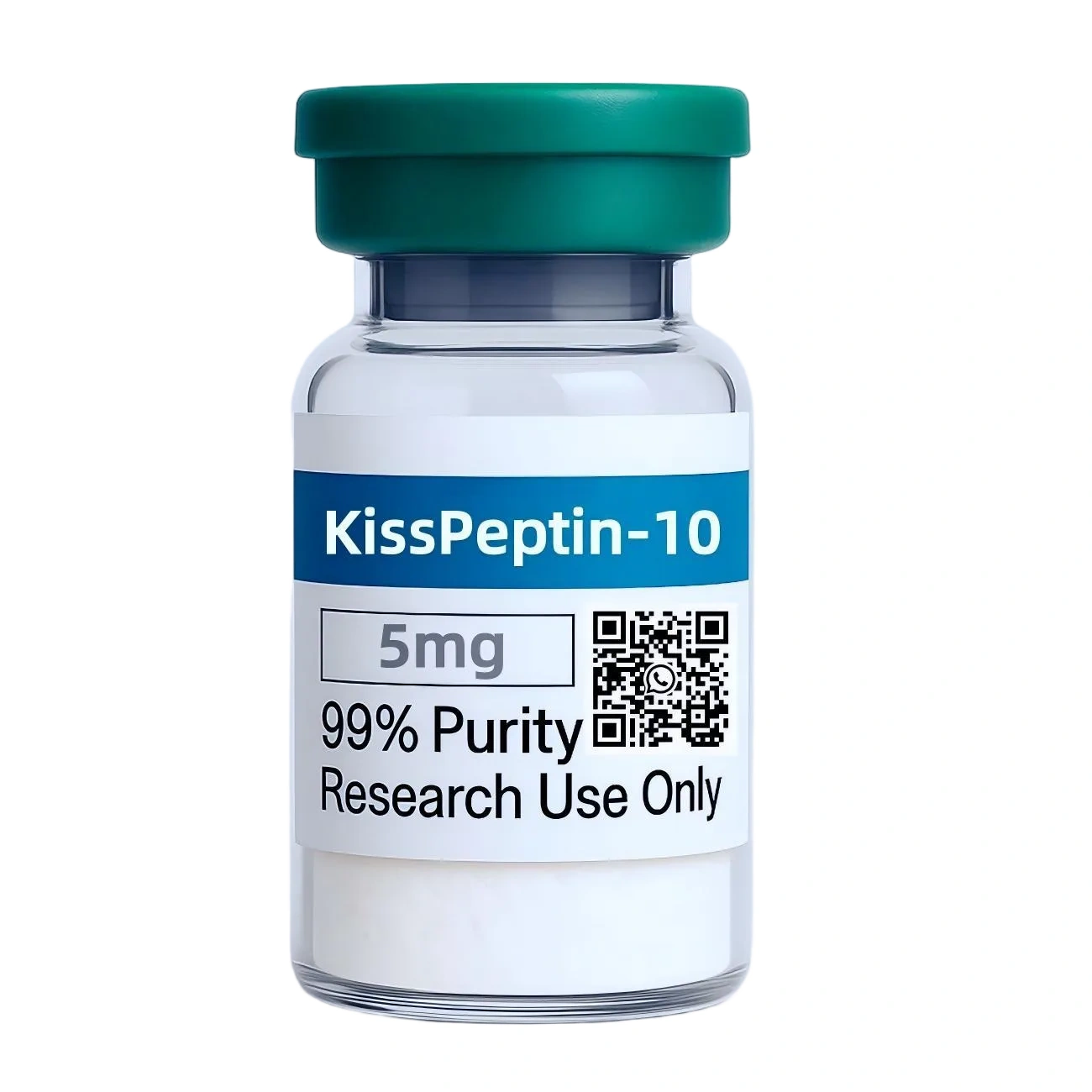
Endogenous neuropeptide and ligand of the KISS1R receptor. Investigated for its role in GnRH pulse generation and the neuroendocrine regulation of reproduction.
KissPeptin-10 is a research compound available through our china peptide catalog as a finished, lyophilized vial from an established Chinese manufacturer. It belongs to the RFamide neuropeptide (C-terminal kisspeptin fragment)
Research Areas
HPG axis physiology, GnRH pulse regulation, puberty biology, reproductive neuroendocrinology, fertility research
Available Variants
| Name | Strength | Pack Size | Purity | Availability |
|---|---|---|---|---|
| KissPeptin-10 | 5 mg | 10 vials | ≥98% | In Stock |
| KissPeptin-10 | 10 mg | 10 vials | — | In Stock |
| KissPeptin-10 | 10 mg | 10 vials | ≥98% | In Stock |
Specification Highlights
Quality & Testing
Testing method: HPLC / LC-MS ([“HPLC”,“LC-MS”,“Endotoxins”,“Assay”,“Water Content”]) . Products are supplied against the specification shown on the applicable product page. The standard catalog purity specification is ≥98% unless otherwise stated. Product-specific specifications and quality-control information may vary by compound and batch. Available documentation: .
**Where provided, these documents reflect the manufacturer’s batch testing for this compound.
Research Areas
GnRH Pulse Regulation Research Kisspeptin-10 is a primary research tool for studying GnRH neuron activation. Studies in rodent and sheep models have characterized the dose-response relationship between kisspeptin-10 administration and GnRH pulse frequency/amplitude, LH surge induction, and ovulation. Arcuate nucleus kisspeptin neuron populations co-express NKB and dynorphin (KNDy neurons), forming the pulse-generating circuit for GnRH. Kisspeptin-10 is used to pharmacologically test GPR54 responsiveness of GnRH neurons in these circuit studies. Puberty Onset and Developmental Neuroendocrinology Kisspeptin signaling is essential for the hormonal changes that trigger puberty. Research has examined how kisspeptin neuronal activity increases during prepuberty, how sex steroid feedback regulates arcuate and AVPV kisspeptin neuron populations, and how kisspeptin-10 administration to prepubertal rodents can advance puberty onset. These studies contribute to understanding of the neuroendocrine switch that initiates the HPG axis activation at puberty. Seasonal Reproduction Research In seasonally breeding mammals (sheep, hamsters), kisspeptin neuronal populations in the arcuate nucleus undergo photoperiod-dependent changes that regulate seasonal HPG axis activity. Research has used kisspeptin-10 administration to test GPR54 responsiveness across reproductive seasons and examined whether exogenous kisspeptin can override photoperiodic suppression. This seasonal reproduction research provides insights into how the kisspeptin system integrates environmental signals with reproductive timing. ## Sourcing KissPeptin-10 From China
KissPeptin-10 is available through our platform as a china peptide sourced directly from an established Chinese manufacturer. Three points define how we handle it:
- Factory-direct, not trader-sourced. We confirm availability and specification with the manufacturer before the order is confirmed. There is no intermediary resale of unknown-origin vials in this catalog.
- Specification before shipment. The purity and concentration specification shown on this page is the manufacturer’s batch specification. Product-specific quality-control information travels with the order.
- Research-use discipline. Like every listing in our catalog, KissPeptin-10 is supplied for laboratory research use only, under strict research-use terms.
For buyers comparing chinese peptides suppliers, the practical test is whether the seller can name the manufacturer and show the batch documentation. We work the other way around: the manufacturer and the documentation are the offer. Browse the full catalog or see how sourcing works.
Available Variants
| Name | Strength | Pack Size | Purity | Availability |
|---|---|---|---|---|
| KissPeptin-10 | 5 mg | 10 vials | ≥98% | In Stock |
| KissPeptin-10 | 10 mg | 10 vials | — | In Stock |
| KissPeptin-10 | 10 mg | 10 vials | ≥98% | In Stock |
Specification Highlights
Quality & Testing
Testing method: HPLC / LC-MS ([“HPLC”,“LC-MS”,“Endotoxins”,“Assay”,“Water Content”]) . Products are supplied against the specification shown on the applicable product page. The standard catalog purity specification is ≥98% unless otherwise stated. Product-specific specifications and quality-control information may vary by compound and batch. Available documentation: .
**Where provided, these documents reflect the manufacturer’s batch testing for this compound.
Research Areas
GnRH Pulse Regulation Research Kisspeptin-10 is a primary research tool for studying GnRH neuron activation. Studies in rodent and sheep models have characterized the dose-response relationship between kisspeptin-10 administration and GnRH pulse frequency/amplitude, LH surge induction, and ovulation. Arcuate nucleus kisspeptin neuron populations co-express NKB and dynorphin (KNDy neurons), forming the pulse-generating circuit for GnRH. Kisspeptin-10 is used to pharmacologically test GPR54 responsiveness of GnRH neurons in these circuit studies. Puberty Onset and Developmental Neuroendocrinology Kisspeptin signaling is essential for the hormonal changes that trigger puberty. Research has examined how kisspeptin neuronal activity increases during prepuberty, how sex steroid feedback regulates arcuate and AVPV kisspeptin neuron populations, and how kisspeptin-10 administration to prepubertal rodents can advance puberty onset. These studies contribute to understanding of the neuroendocrine switch that initiates the HPG axis activation at puberty. Seasonal Reproduction Research In seasonally breeding mammals (sheep, hamsters), kisspeptin neuronal populations in the arcuate nucleus undergo photoperiod-dependent changes that regulate seasonal HPG axis activity. Research has used kisspeptin-10 administration to test GPR54 responsiveness across reproductive seasons and examined whether exogenous kisspeptin can override photoperiodic suppression. This seasonal reproduction research provides insights into how the kisspeptin system integrates environmental signals with reproductive timing.
Compound Profile
Kisspeptin-10 is the C-terminal decapeptide of kisspeptin (also known as metastin), the endogenous neuropeptide product of the KISS1 gene. Kisspeptins are processed from a 145-amino acid precursor into fragments of varying lengths (kisspeptin-54, -14, -13, -10), all of which share the C-terminal decapeptide sequence that is required for GPR54/KISS1R receptor binding. Kisspeptin-10 — the minimally active binding fragment — is the most widely used research form due to its small size, ease of synthesis, and equipotent activity to longer kisspeptin isoforms at GPR54. Kisspeptin and GPR54 are essential regulators of the hypothalamic-pituitary-gonadal (HPG) axis. Kisspeptin neurons in the arcuate nucleus and anteroventral periventricular nucleus (AVPV) integrate sex steroid feedback signals and project directly onto GnRH (gonadotropin-releasing hormone) neurons, stimulating GnRH pulse release. Loss-of-function mutations in KISS1 or GPR54 result in hypogonadotropic hypogonadism in rodents and humans — establishing kisspeptin/GPR54 as the upstream activator of reproductive endocrine function. Research applications include HPG axis physiology, puberty onset mechanisms, seasonal reproduction biology, and fertility research. Peptides of China supplies Kisspeptin-10 as a lyophilized powder at 99%+ purity, verified by HPLC and Mass Spectrometry. Every batch is tested by the manufacturer for purity and concentration as part of routine quality control. All products are for laboratory research use only and are not for human consumption.
Profile
Research Areas
HPG axis physiology, GnRH pulse regulation, puberty biology, reproductive neuroendocrinology, fertility research
Available Variants
| Name | Strength | Pack Size | Purity | Availability |
|---|---|---|---|---|
| KissPeptin-10 | 5 mg | 10 vials | ≥98% | In Stock |
| KissPeptin-10 | 10 mg | 10 vials | — | In Stock |
| KissPeptin-10 | 10 mg | 10 vials | ≥98% | In Stock |
Specification Highlights
Quality & Testing
Testing method: HPLC / LC-MS ([“HPLC”,“LC-MS”,“Endotoxins”,“Assay”,“Water Content”]) . Products are supplied against the specification shown on the applicable product page. The standard catalog purity specification is ≥98% unless otherwise stated. Product-specific specifications and quality-control information may vary by compound and batch. Available documentation: .
**Where provided, these documents reflect the manufacturer’s batch testing for this compound.
Research Areas
GnRH Pulse Regulation Research Kisspeptin-10 is a primary research tool for studying GnRH neuron activation. Studies in rodent and sheep models have characterized the dose-response relationship between kisspeptin-10 administration and GnRH pulse frequency/amplitude, LH surge induction, and ovulation. Arcuate nucleus kisspeptin neuron populations co-express NKB and dynorphin (KNDy neurons), forming the pulse-generating circuit for GnRH. Kisspeptin-10 is used to pharmacologically test GPR54 responsiveness of GnRH neurons in these circuit studies. Puberty Onset and Developmental Neuroendocrinology Kisspeptin signaling is essential for the hormonal changes that trigger puberty. Research has examined how kisspeptin neuronal activity increases during prepuberty, how sex steroid feedback regulates arcuate and AVPV kisspeptin neuron populations, and how kisspeptin-10 administration to prepubertal rodents can advance puberty onset. These studies contribute to understanding of the neuroendocrine switch that initiates the HPG axis activation at puberty. Seasonal Reproduction Research In seasonally breeding mammals (sheep, hamsters), kisspeptin neuronal populations in the arcuate nucleus undergo photoperiod-dependent changes that regulate seasonal HPG axis activity. Research has used kisspeptin-10 administration to test GPR54 responsiveness across reproductive seasons and examined whether exogenous kisspeptin can override photoperiodic suppression. This seasonal reproduction research provides insights into how the kisspeptin system integrates environmental signals with reproductive timing.