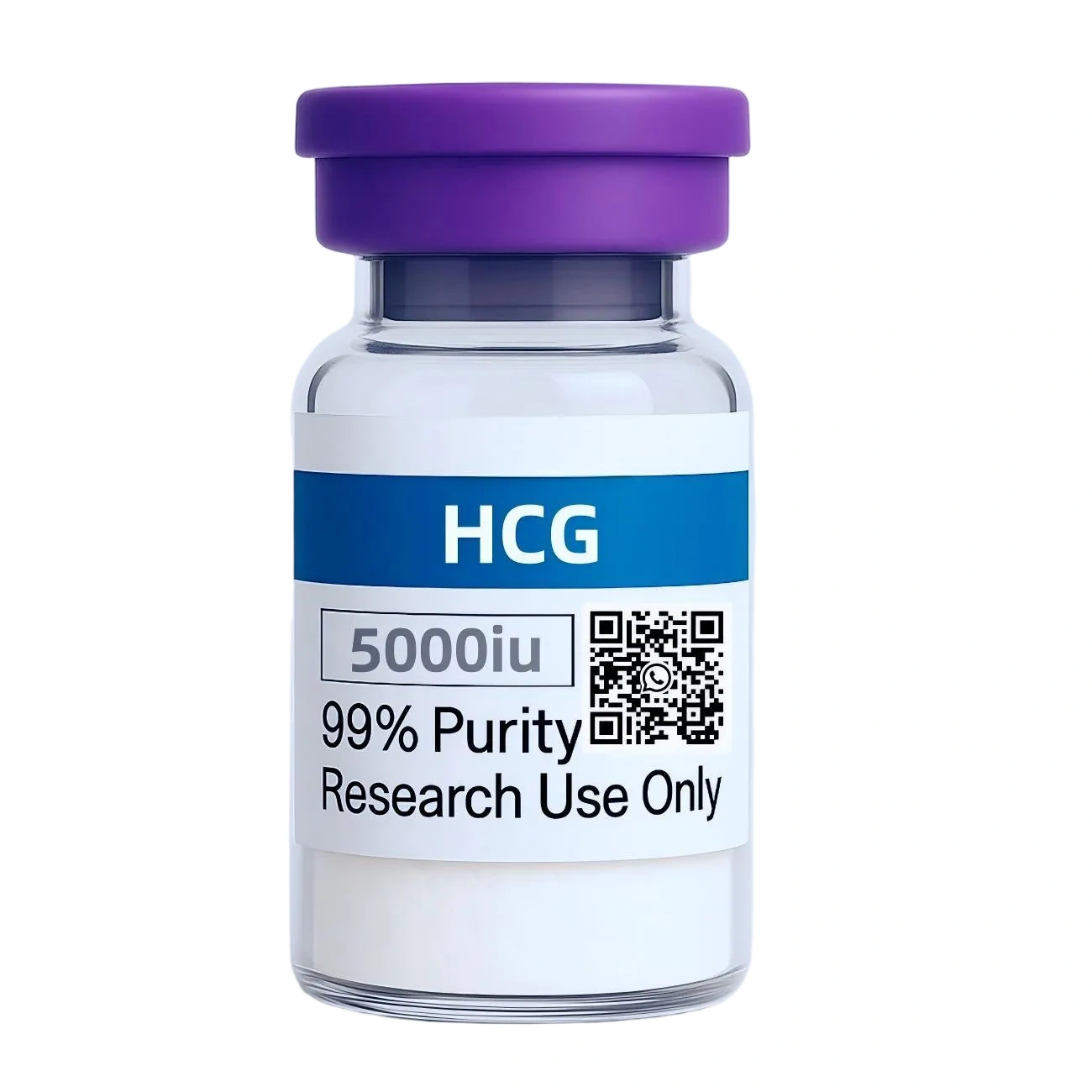
Human chorionic gonadotropin — an LH-mimetic glycoprotein hormone. Subject of research into Leydig cell stimulation, testosterone biosynthesis, and HPG axis function.
HCG is a research compound available through our china peptide catalog as a finished, lyophilized vial from an established Chinese manufacturer. It belongs to the Glycoprotein Gonadotropin / LH Receptor Agonist
Available Variants
| Name | Strength | Pack Size | Purity | Availability |
|---|---|---|---|---|
| HCG | 5000 IU | 10 vials | ≥98% | In Stock |
| HCG | 5000 IU | 10 vials | — | In Stock |
| HCG | 10000 IU | 10 vials | ≥98% | In Stock |
| HCG | 10000 IU | 10 vials | — | In Stock |
Specification Highlights
Quality & Testing
Testing method: HPLC / LC-MS ([“HPLC”,“LC-MS”,“Endotoxins”,“Sterility”]) . Products are supplied against the specification shown on the applicable product page. The standard catalog purity specification is ≥98% unless otherwise stated. Product-specific specifications and quality-control information may vary by compound and batch. Available documentation: .
**Where provided, these documents reflect the manufacturer’s batch testing for this compound.
Research Areas
LH Receptor Pharmacology & Leydig Cell Research LHCGR is a G-protein coupled receptor (Gs class) expressed on Leydig cells in the testis and granulosa/luteal cells in the ovary. HCG binding activates adenylyl cyclase, elevating cAMP and activating PKA, which drives cholesterol mobilisation to mitochondria via StAR protein and subsequent steroidogenesis through CYP11A1, CYP17A1, and HSD17B pathways. Primary Leydig cell cultures and MLTC-1 or TM3 Leydig cell lines are standard in vitro formats for characterising HCG-stimulated testosterone production (RIA or ELISA) and cAMP accumulation. LHCGR expression level, receptor desensitisation kinetics, and beta-arrestin recruitment are characterised alongside testosterone output. HPG Axis Research & Testosterone Stimulation Tests The HCG stimulation test is a pharmacological probe for Leydig cell steroidogenic reserve in rodent models. A single injection of HCG (10–100 IU in rats; 25–250 IU in primates) produces a testosterone peak at 2–6 hours that reflects LHCGR number, coupling efficiency, and steroidogenic enzyme capacity. In models of HPG axis suppression (GnRH agonist treatment, androgen suppression, orchiectomy), the HCG stimulation test characterises testicular reserve recovery. In hypogonadotropic hypogonadism models (GnRH receptor knockout mice), HCG bypasses the pituitary and directly stimulates testicular testosterone — allowing dissection of gonadotropin-independent testicular function. Female Reproductive Biology & Ovulation Research In female rodent superovulation protocols, HCG is administered 48 hours after PMSG (equine chorionic gonadotropin) priming to trigger the LH surge and induce ovulation — the standard protocol for generating metaphase II oocytes for IVF research. LHCGR on granulosa cells mediates luteinisation (conversion to progesterone-secreting luteal cells) and oocyte maturation resumption. Granulosa cell models use HCG to characterise progesterone synthesis, cumulus expansion (hyaluronic acid secretion), and EGF receptor pathway activation, which mediates oocyte maturation signals downstream of the LH/HCG surge. GnRH Analogue & HPG Axis Recovery Studies Research into HPG axis recovery following GnRH agonist or antagonist treatment uses HCG to assess Leydig cell function independently of pituitary LH secretion. In rodent models of chemical castration (buserelin, leuprolide), serial HCG stimulation tests document the timeline of testicular steroidogenic recovery as Leydig cell LHCGR expression normalises. These models are relevant to the broader field of HPG axis pharmacology including research into gonadorelin, kisspeptin-10, and GnRH antagonist reversal — all of which rely on intact Leydig cell responsiveness to gonadotropin stimulation as the functional endpoint. ## Sourcing HCG From China
HCG is available through our platform as a china peptide sourced directly from an established Chinese manufacturer. Three points define how we handle it:
- Factory-direct, not trader-sourced. We confirm availability and specification with the manufacturer before the order is confirmed. There is no intermediary resale of unknown-origin vials in this catalog.
- Specification before shipment. The purity and concentration specification shown on this page is the manufacturer’s batch specification. Product-specific quality-control information travels with the order.
- Research-use discipline. Like every listing in our catalog, HCG is supplied for laboratory research use only, under strict research-use terms.
For buyers comparing chinese peptides suppliers, the practical test is whether the seller can name the manufacturer and show the batch documentation. We work the other way around: the manufacturer and the documentation are the offer. Browse the full catalog or see how sourcing works.
Compound Profile
Human chorionic gonadotropin (HCG) is a glycoprotein hormone structurally homologous to luteinising hormone (LH), follicle-stimulating hormone (FSH), and thyroid-stimulating hormone (TSH). It is a heterodimer consisting of a non-covalently associated alpha subunit (92 amino acids, common to all four glycoprotein hormones) and a beta subunit (145 amino acids, unique to HCG and responsible for receptor specificity) — linked by two N-linked and four O-linked oligosaccharide chains that account for approximately 30% of the total molecular weight and are essential for biological activity and plasma half-life. The high-affinity binding of the HCG beta subunit to the LH receptor (LHCGR) enables it to mimic and sustain LH signalling, most critically the sustained Leydig cell testosterone stimulation that maintains corpus luteum function in early pregnancy. For research applications, recombinant or urinary-derived HCG is used as an LH receptor agonist in reproductive biology, HPG axis pharmacology, and steroidogenesis studies. The research utility of HCG spans endocrine and reproductive biology: it is the standard positive control for LH receptor activation assays, the reference agonist for Leydig cell testosterone production studies, and a tool compound for HPG axis suppression-recovery protocols in male reproductive research models. HCG’s longer half-life than native LH (t½ ~24–36 h vs. ~1 h for LH) makes it the preferred ligand for sustained receptor stimulation in prolonged in vitro or in vivo assays. In hypothalamo-pituitary-gonadal (HPG) axis research, the HCG stimulation test — measuring testosterone response to a defined HCG dose — is the pharmacological gold standard for assessing Leydig cell reserve and testicular steroidogenic capacity in rodent and primate models. Peptides of China supplies research-grade HCG as lyophilized powder, purity-verified by HPLC and bioactivity-assessed by international unit (IU) calibration against the WHO reference standard. Certificates of Analysis per batch. Wholesale quantities on request. For laboratory research use only.
Profile
Available Variants
| Name | Strength | Pack Size | Purity | Availability |
|---|---|---|---|---|
| HCG | 5000 IU | 10 vials | ≥98% | In Stock |
| HCG | 5000 IU | 10 vials | — | In Stock |
| HCG | 10000 IU | 10 vials | ≥98% | In Stock |
| HCG | 10000 IU | 10 vials | — | In Stock |
Specification Highlights
Quality & Testing
Testing method: HPLC / LC-MS ([“HPLC”,“LC-MS”,“Endotoxins”,“Sterility”]) . Products are supplied against the specification shown on the applicable product page. The standard catalog purity specification is ≥98% unless otherwise stated. Product-specific specifications and quality-control information may vary by compound and batch. Available documentation: .
**Where provided, these documents reflect the manufacturer’s batch testing for this compound.
Research Areas
LH Receptor Pharmacology & Leydig Cell Research LHCGR is a G-protein coupled receptor (Gs class) expressed on Leydig cells in the testis and granulosa/luteal cells in the ovary. HCG binding activates adenylyl cyclase, elevating cAMP and activating PKA, which drives cholesterol mobilisation to mitochondria via StAR protein and subsequent steroidogenesis through CYP11A1, CYP17A1, and HSD17B pathways. Primary Leydig cell cultures and MLTC-1 or TM3 Leydig cell lines are standard in vitro formats for characterising HCG-stimulated testosterone production (RIA or ELISA) and cAMP accumulation. LHCGR expression level, receptor desensitisation kinetics, and beta-arrestin recruitment are characterised alongside testosterone output. HPG Axis Research & Testosterone Stimulation Tests The HCG stimulation test is a pharmacological probe for Leydig cell steroidogenic reserve in rodent models. A single injection of HCG (10–100 IU in rats; 25–250 IU in primates) produces a testosterone peak at 2–6 hours that reflects LHCGR number, coupling efficiency, and steroidogenic enzyme capacity. In models of HPG axis suppression (GnRH agonist treatment, androgen suppression, orchiectomy), the HCG stimulation test characterises testicular reserve recovery. In hypogonadotropic hypogonadism models (GnRH receptor knockout mice), HCG bypasses the pituitary and directly stimulates testicular testosterone — allowing dissection of gonadotropin-independent testicular function. Female Reproductive Biology & Ovulation Research In female rodent superovulation protocols, HCG is administered 48 hours after PMSG (equine chorionic gonadotropin) priming to trigger the LH surge and induce ovulation — the standard protocol for generating metaphase II oocytes for IVF research. LHCGR on granulosa cells mediates luteinisation (conversion to progesterone-secreting luteal cells) and oocyte maturation resumption. Granulosa cell models use HCG to characterise progesterone synthesis, cumulus expansion (hyaluronic acid secretion), and EGF receptor pathway activation, which mediates oocyte maturation signals downstream of the LH/HCG surge. GnRH Analogue & HPG Axis Recovery Studies Research into HPG axis recovery following GnRH agonist or antagonist treatment uses HCG to assess Leydig cell function independently of pituitary LH secretion. In rodent models of chemical castration (buserelin, leuprolide), serial HCG stimulation tests document the timeline of testicular steroidogenic recovery as Leydig cell LHCGR expression normalises. These models are relevant to the broader field of HPG axis pharmacology including research into gonadorelin, kisspeptin-10, and GnRH antagonist reversal — all of which rely on intact Leydig cell responsiveness to gonadotropin stimulation as the functional endpoint.