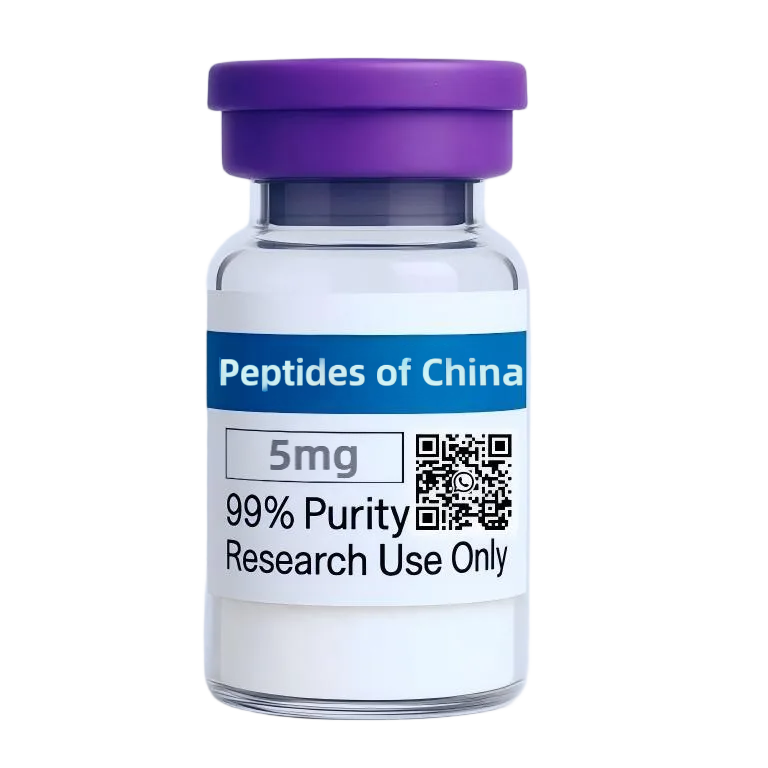
Human cathelicidin antimicrobial peptide (hCAP-18 C-terminal fragment).
LL-37 is a research compound available through our china peptide catalog as a finished, lyophilized vial from an established Chinese manufacturer. It belongs to the Human cathelicidin antimicrobial peptide (AMP)
Research Areas
Innate immunity, antimicrobial pharmacology, wound healing, immunomodulation, TLR signaling, cancer biology
Available Variants
| Name | Strength | Pack Size | Purity | Availability |
|---|---|---|---|---|
| LL-37 | 5 mg | 10 vials | ≥98% | In Stock |
Specification Highlights
Quality & Testing
Testing method: HPLC / LC-MS . Products are supplied against the specification shown on the applicable product page. The standard catalog purity specification is ≥98% unless otherwise stated. Product-specific specifications and quality-control information may vary by compound and batch. Every batch is tested by the manufacturer for purity and concentration as part of routine quality control, using methods such as HPLC and LC-MS. These results are kept in the manufacturer’s internal quality-control records and are not issued as a separate certificate or document.
Research Areas
Antimicrobial Mechanism Research LL-37 exhibits broad-spectrum antimicrobial activity against Gram-positive and Gram-negative bacteria, fungi, and some enveloped viruses. Its amphipathic helical structure enables membrane insertion and disruption of bacterial lipid bilayers — a mechanism studied as a basis for resistance-proof antimicrobial design. Minimum inhibitory concentration (MIC) studies, membrane permeabilization assays, and resistance evolution experiments using LL-37 as a reference AMP are core applications in antimicrobial peptide research. Innate Immunity and Immunomodulation LL-37 acts on multiple innate immune cell types via receptor-mediated signaling: FPR2/ALX on neutrophils and macrophages, P2X7 on dendritic cells, and FPRL1 on monocytes. Research has examined LL-37’s role in TLR4 and TLR9 signaling modulation — both potentiating and suppressing TLR-mediated inflammation depending on context and concentration. These immunomodulatory properties make LL-37 a tool for studying the boundary between direct antimicrobial action and immune cell signaling in innate defense research. Wound Healing and Angiogenesis Research has documented LL-37’s ability to promote wound closure in ex vivo and rodent wound healing models via EGFR transactivation and FPR2-mediated cell migration signaling. Studies have examined re-epithelialization rates, keratinocyte proliferation, and angiogenic marker expression following LL-37 application to wound models. This wound-healing activity — separate from its antimicrobial properties — has generated research interest in LL-37 as a dual-function peptide for tissue repair biology. ## Sourcing LL-37 From China
LL-37 is available through our platform as a china peptide sourced directly from an established Chinese manufacturer. Three points define how we handle it:
- Factory-direct, not trader-sourced. We confirm availability and specification with the manufacturer before the order is confirmed. There is no intermediary resale of unknown-origin vials in this catalog.
- Specification before shipment. The purity and concentration specification shown on this page is the manufacturer’s batch specification. Product-specific quality-control information travels with the order.
- Research-use discipline. Like every listing in our catalog, LL-37 is supplied for laboratory research use only, under strict research-use terms.
For buyers comparing chinese peptides suppliers, the practical test is whether the seller can name the manufacturer and show the batch documentation. We work the other way around: the manufacturer and the documentation are the offer. Browse the full catalog or see how sourcing works.
Available Variants
| Name | Strength | Pack Size | Purity | Availability |
|---|---|---|---|---|
| LL-37 | 5 mg | 10 vials | ≥98% | In Stock |
Specification Highlights
Quality & Testing
Testing method: HPLC / LC-MS . Products are supplied against the specification shown on the applicable product page. The standard catalog purity specification is ≥98% unless otherwise stated. Product-specific specifications and quality-control information may vary by compound and batch. Every batch is tested by the manufacturer for purity and concentration as part of routine quality control, using methods such as HPLC and LC-MS. These results are kept in the manufacturer’s internal quality-control records and are not issued as a separate certificate or document.
Research Areas
Antimicrobial Mechanism Research LL-37 exhibits broad-spectrum antimicrobial activity against Gram-positive and Gram-negative bacteria, fungi, and some enveloped viruses. Its amphipathic helical structure enables membrane insertion and disruption of bacterial lipid bilayers — a mechanism studied as a basis for resistance-proof antimicrobial design. Minimum inhibitory concentration (MIC) studies, membrane permeabilization assays, and resistance evolution experiments using LL-37 as a reference AMP are core applications in antimicrobial peptide research. Innate Immunity and Immunomodulation LL-37 acts on multiple innate immune cell types via receptor-mediated signaling: FPR2/ALX on neutrophils and macrophages, P2X7 on dendritic cells, and FPRL1 on monocytes. Research has examined LL-37’s role in TLR4 and TLR9 signaling modulation — both potentiating and suppressing TLR-mediated inflammation depending on context and concentration. These immunomodulatory properties make LL-37 a tool for studying the boundary between direct antimicrobial action and immune cell signaling in innate defense research. Wound Healing and Angiogenesis Research has documented LL-37’s ability to promote wound closure in ex vivo and rodent wound healing models via EGFR transactivation and FPR2-mediated cell migration signaling. Studies have examined re-epithelialization rates, keratinocyte proliferation, and angiogenic marker expression following LL-37 application to wound models. This wound-healing activity — separate from its antimicrobial properties — has generated research interest in LL-37 as a dual-function peptide for tissue repair biology.
Compound Profile
LL-37 is the only known human cathelicidin antimicrobial peptide, derived from the C-terminal cleavage of the precursor protein hCAP18 (human cationic antimicrobial protein 18). The 37-amino acid sequence — LLGDFFRKSKEKIGKEFKRIVQRIKDFLRNLVPRTES — begins with two leucine residues (LL) and terminates at residue 37, giving rise to its designation. As an amphipathic α-helical peptide, LL-37 adopts a helical conformation in the presence of anionic membranes, which is central to its membrane-disruption activity against bacteria and its interaction with mammalian cell surface receptors. Research interest in LL-37 spans multiple fields. In innate immunity, it functions as both a direct antimicrobial agent and an immunomodulator — activating dendritic cells, macrophages, and mast cells, inducing cytokine production, and modulating Toll-like receptor (TLR) signaling. In wound healing research, LL-37 has been studied for its ability to promote re-epithelialization and angiogenesis via formyl peptide receptor 2 (FPR2/ALX) and EGFR transactivation. More recently, research has examined LL-37 in the context of cancer biology — where it exhibits context-dependent roles, acting as a tumor suppressor in some cancers and a growth promoter in others. Peptides of China supplies LL-37 as a lyophilized powder at 99%+ purity, verified by HPLC and Mass Spectrometry. Every batch is tested by the manufacturer for purity and concentration as part of routine quality control. All products are for laboratory research use only and are not for human consumption.
Profile
Research Areas
Innate immunity, antimicrobial pharmacology, wound healing, immunomodulation, TLR signaling, cancer biology
Available Variants
| Name | Strength | Pack Size | Purity | Availability |
|---|---|---|---|---|
| LL-37 | 5 mg | 10 vials | ≥98% | In Stock |
Specification Highlights
Quality & Testing
Testing method: HPLC / LC-MS . Products are supplied against the specification shown on the applicable product page. The standard catalog purity specification is ≥98% unless otherwise stated. Product-specific specifications and quality-control information may vary by compound and batch. Every batch is tested by the manufacturer for purity and concentration as part of routine quality control, using methods such as HPLC and LC-MS. These results are kept in the manufacturer’s internal quality-control records and are not issued as a separate certificate or document.
Research Areas
Antimicrobial Mechanism Research LL-37 exhibits broad-spectrum antimicrobial activity against Gram-positive and Gram-negative bacteria, fungi, and some enveloped viruses. Its amphipathic helical structure enables membrane insertion and disruption of bacterial lipid bilayers — a mechanism studied as a basis for resistance-proof antimicrobial design. Minimum inhibitory concentration (MIC) studies, membrane permeabilization assays, and resistance evolution experiments using LL-37 as a reference AMP are core applications in antimicrobial peptide research. Innate Immunity and Immunomodulation LL-37 acts on multiple innate immune cell types via receptor-mediated signaling: FPR2/ALX on neutrophils and macrophages, P2X7 on dendritic cells, and FPRL1 on monocytes. Research has examined LL-37’s role in TLR4 and TLR9 signaling modulation — both potentiating and suppressing TLR-mediated inflammation depending on context and concentration. These immunomodulatory properties make LL-37 a tool for studying the boundary between direct antimicrobial action and immune cell signaling in innate defense research. Wound Healing and Angiogenesis Research has documented LL-37’s ability to promote wound closure in ex vivo and rodent wound healing models via EGFR transactivation and FPR2-mediated cell migration signaling. Studies have examined re-epithelialization rates, keratinocyte proliferation, and angiogenic marker expression following LL-37 application to wound models. This wound-healing activity — separate from its antimicrobial properties — has generated research interest in LL-37 as a dual-function peptide for tissue repair biology.